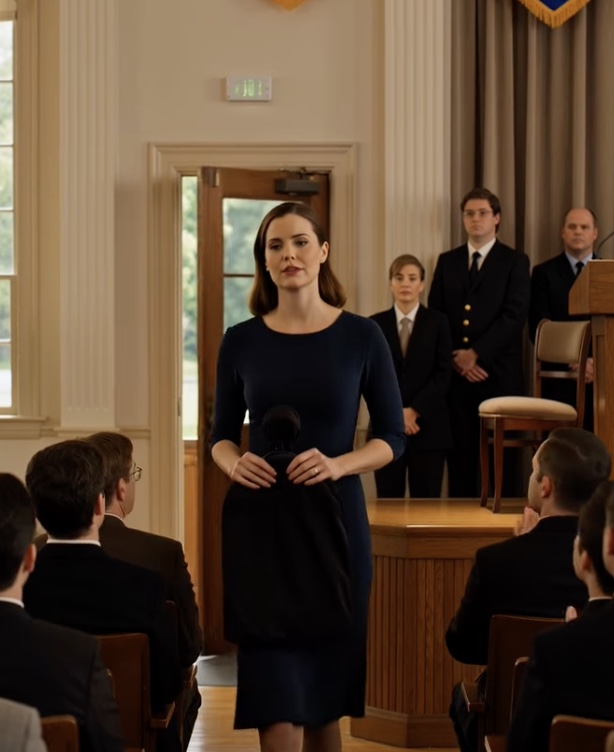
I came home for my father’s veterans’ ceremony wearing a plain navy dress, clutching my service cover in a small garment bag. I didn’t want anyone to notice me. I didn’t want the attention. I only wanted to see my father honored.
Captain Robert Hayes had served twenty-eight years in the Navy. To everyone in our small Virginia town, he was a hero. To me, he was Dad—the man who had taught me how to tie a square knot, change a tire, and stand straight when life tried to bend me. I hadn’t seen him in months; deployments, classified assignments, and an endless chain of alerts had kept me away.
The ceremony hall was packed. Veterans in uniform filled the front rows. Families held flowers. A brass band tuned near the stage. The smell of polished shoes and fresh carnations mixed with the faint scent of gunmetal from the folded flags stacked neatly along the stage.
Linda, my stepmother, stood beside the podium in a red suit, smiling like she owned the room. My heart sank the moment I saw her. That smile wasn’t for my father—it was for her audience, her power, her claim on our family legacy.
Then she saw me.
Her expression sharpened instantly. “Well,” she said, loud enough for nearby people to hear, “Sarah decided to show up after all.”
I swallowed hard and slid into a seat in the back row, keeping my head low. My stepmother leaned toward the woman beside her, smirking. “She left the Navy months ago. Poor thing couldn’t handle it. Robert never wanted to admit that.”
The words spread quickly. A few heads turned. Whispers fluttered like birds in a cage.
I clenched my hands in my lap, forcing myself to remain invisible.
The truth? I hadn’t left the Navy. Not even close. I had been deployed. Far away. On a mission so classified I couldn’t speak of it to anyone, not even my father. I had seen things, done things, survived things that would have made ordinary civilians shiver in fear. I still woke up some nights hearing alarms that weren’t there.
Dad knew only fragments, the half-truths that the Navy permitted him to know. Linda, of course, knew nothing, because she had never cared to ask.
The mayor stepped up to the microphone. “Today, we honor Captain Robert Hayes and his family’s proud legacy of service.”
Linda lifted her chin like she owned that legacy. The brass band struck a note of patriotic fervor. Applause echoed from the front rows. My father, seated in his wheelchair, watched with pride that I had no right to claim.
And then, the doors opened.
A man in dress whites entered the crowded hall. Tall. Silver-haired. Admiral’s stars gleaming on his shoulders.
The room went silent. Every eye followed him, expecting the usual protocol: straight to the stage, nods, handshakes, applause.
He ignored the stage.
He ignored the mayor.
He ignored Linda and the reserved front row of distinguished guests.
Instead, Admiral Thomas Whitaker walked straight down the aisle toward me.
I froze. My chest thumped violently against my ribs. My service cover seemed suddenly heavy in my lap.
He stopped directly in front of me.
I rose, unable to look away.
He saluted.
“Commander Hayes,” he said, his voice steady, carrying through the packed hall, “welcome home.”
Time seemed to stop.
Linda’s face drained of color. The smirk vanished. I could almost see her wheels turning, realizing that the truth she had tried to write in whispers and insults could not be erased by her words.
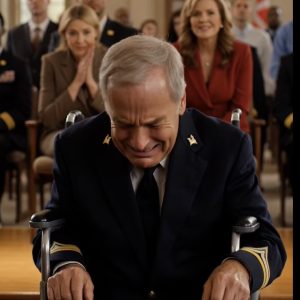
My father, sitting on the stage in his wheelchair, began to cry. Tears rolled down his weathered cheeks. His hands trembled as he pressed them together, trying to hide the emotions that his lifelong stoicism rarely permitted. I could see it in his eyes—the mixture of pride, disbelief, and uncontainable relief.
I sank to one knee in front of him. “Dad,” I whispered, though the hall was silent enough for my voice to carry. “I’m home.”
The ceremony continued around us, but for a moment, the room ceased to exist. There were no brass bands, no speeches, no applause—only my father, Linda’s stunned silence, and the Admiral standing behind me, like a sentinel.
The story of that deployment had never been mine to tell, but as the ceremony wore on, small details began to emerge. Whispers from old comrades, knowing glances from Navy friends, the unspoken nods of men and women who understood exactly what I had endured.
I remembered the nights in the desert, where alarms screamed across the sky and shadows moved in impossible ways. I remembered the convoy ambushed in the dead of night, the radio silence that lasted hours, and the orders I could neither defy nor explain to anyone back home.
I remembered feeling utterly alone in a foreign land, counting down hours until I could hear my father’s voice again, hoping he never learned the full truth, because some truths were too heavy for those left behind.
And now, here I was. Sitting in the back row, my plain navy dress contrasting with the medals, ribbons, and starched whites of the ceremony, feeling every pair of eyes that had once doubted me now shift in silent acknowledgment.
Linda’s lips pressed into a thin line. She looked at the Admiral, who met her gaze with nothing but respect and authority. She understood, even if she couldn’t say it aloud, that the story she had tried to write about me—the story of failure, of weakness—was a lie.
After the ceremony, the hall cleared slowly. Families approached the stage, veterans clasped hands and exchanged nods, but the most important exchange was happening in a small, quiet aisle in the back. My father wheeled himself toward me, his hands trembling as they gripped mine.
“You… you kept me safe,” he said, voice breaking. “I—I didn’t know if you’d come back.”
Tears burned my eyes. “I did it for you,” I said, choking on my words. “For all of us.”
He shook his head, overwhelmed. “I’m so proud… so damn proud.”
The Admiral rested a hand on my shoulder. “You did what few could, Commander. And you did it without needing recognition. That’s true service.”
I nodded, speechless. The weight of years, the loneliness, the danger—all the moments when I had felt invisible—suddenly lifted in the glow of acknowledgment from the one man whose pride mattered most.
Linda finally moved toward us, her expression unreadable. I expected confrontation, a sharp comment, something to claw back the narrative she had tried to control. But she paused, lips tight, and then turned away. Perhaps some truths are too powerful to be denied, no matter how much someone wants to spin them.
I looked around the hall. The veterans, the brass band, the families—they were all witnesses to something unspoken. A hidden story had been revealed in the smallest, quietest way possible: honor doesn’t always wear medals or ribbons. Sometimes, it walks silently into a crowded room, and the people who understand recognize it immediately.
Later, after the ceremony, my father and I walked outside into the Virginia evening. The sun was low, casting golden light across the flag-lined street. He stopped, wheeled himself onto the grass, and looked at me with the kind of vulnerability reserved for moments when words fail.
“Every night I prayed for your safety,” he said. “I didn’t know where you were, if you were alive… I hated myself for not knowing.”
I knelt beside him. “You did what you could, Dad. I had my mission, my orders. But I always knew I’d come back. I always knew I’d see you again.”
He reached out, and we held hands. The world around us faded. For once, it wasn’t about ceremonies or medals or recognition. It was about family, about the bond that no deployment, no distance, no deception could ever sever.
When we returned inside to gather our things, the hall was almost empty. I caught sight of Linda again. She was talking to a few remaining guests, attempting to salvage some semblance of authority, but I felt no anger, only a strange sense of closure.
For the first time in months, I felt the weight lift off my chest. The fear, the secrecy, the feeling of being unseen—all of it was finally acknowledged. Not by the whispers in the hall, not by the smirks or judgments, but by the man whose respect had always meant the most: my father.
Later that night, at a small dinner with Dad and a few close family friends, I finally allowed myself to share fragments of my experience. The missions I could describe, the moments of tension, the small victories. My father listened intently, eyes wide, occasionally shaking his head in disbelief.
“You never asked for recognition,” he said softly. “You came home quietly, and yet… look at the room today. Look at the faces. Everyone who knows service understood. Even Linda… she just… she couldn’t stop it from showing.”
I smiled, tired but relieved. “That was never the point, Dad. The point was to come back to you. To honor your legacy, not mine.”
He reached across the table, squeezed my hand, and said something I’ll never forget: “Sarah… today, you were a hero. And I got to see it with my own eyes.”
And in that moment, all the months of fear, isolation, and silence evaporated. The story that had been kept in shadows, that had been doubted by those who thought they knew me, had finally been witnessed. Not with medals or speeches, but with acknowledgment, pride, and love.
Some people will never understand the burden of secrets kept for duty, the quiet courage it takes to survive without recognition. But I did not need them to understand. My father did. And for that, every sleepless night, every whispered alarm, every lonely deployment had been worth it.
Even as the hall emptied, even as the last notes of the band faded into memory, I knew that day would stay with me forever. Because sometimes, coming home is not about returning to a place—it’s about returning to the people who matter most. And that evening, I returned not just to a ceremony, not just to applause or acknowledgment, but to the heart of my family.
And my father saw me. Truly saw me.