My husband’s mistress wore my missing Versace dress to my father’s funeral. Sat in the family row. Held my husband’s hand. And an hour later, my father’s lawyer began the will with words that froze me: “To my daughter Natalie, who called me yesterday about her husband’s affair…”
The dress had been missing for three weeks. Midnight blue, the kind that looked black in shadow and sparkled under light, hand-sewn crystals glinting along the neckline. My father had given it to me for my fortieth birthday with a card that read, “For the nights when you want to remember that elegance is armor.” He believed style could protect a woman in ways words never could.

I had searched every closet, garment bag, cedar chest, even the trunk of my car. I accused the dry cleaner, sifted through old boxes, breathing in dust, leather, and stale perfume until my eyes burned. Nothing.
By the morning of the funeral, grief shoved everything else aside. My father was gone. The house smelled of lilies, casseroles, and stale coffee. People spoke in low voices, touching my wrist like I might shatter. I wore black. Simple. Safe.
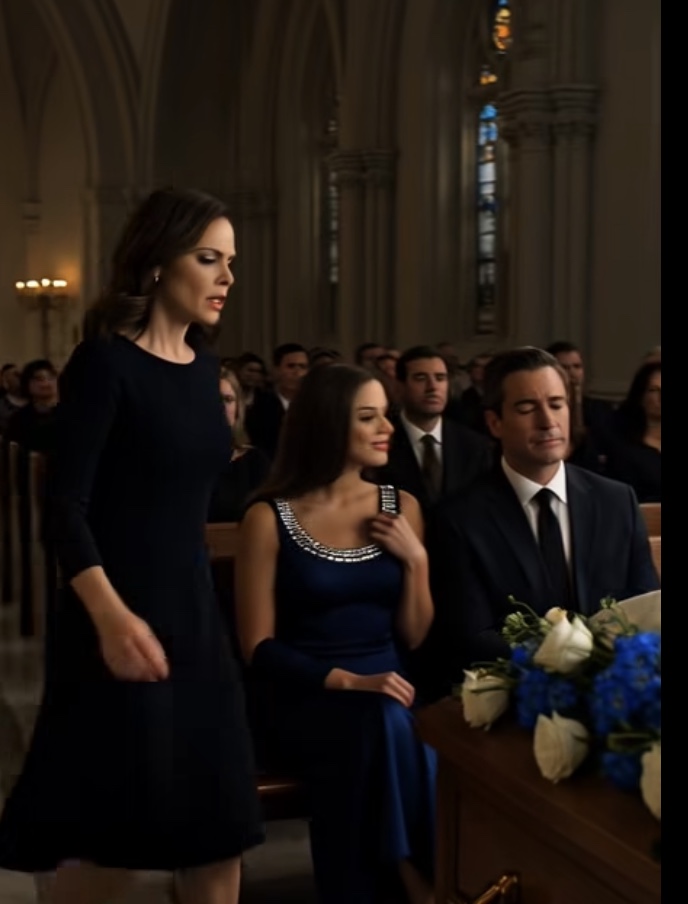
The cathedral was cool and dim—marble floors, stained glass, candle wax drifting through the air. The organ murmured softly under whispered conversations. Polished shoes, loosened ties, the hush of a city’s elite mourning someone they all knew.
I stopped at the back, steadying myself, when I saw him. My husband, Grant. Front row, where he belonged. Except he wasn’t alone.
The woman beside him wore my dress.

For a second, my mind refused to process it. The crystals sparkled under the stained glass, scattering red and blue across the pews. My father’s gift, worn by another woman while he lay dead twenty feet away.
“Becca,” I said, voice flat, strange even to my ears. “What the hell are you doing here?”
Rebecca Thornton turned, the smoothest smile I’ve ever wanted to wipe off a face. Twenty-eight, maybe twenty-nine, glossy brown hair, expensive cheek filler, an effortless charm designed to claim attention. She had worked in marketing at Grant’s firm, and I had met her twice before at corporate events. Both times, she called me “Natalie” with fake warmth that made my blood boil.
“Natalie,” she said softly, as if we were meeting for brunch, not standing before my father’s coffin. “I’m so sorry for your loss.”
Her hand rested on Grant’s. His gaze finally met mine, and the expression struck harder than a slap: calm, collected, yet cold with guilt.
The cathedral seemed to pull tight around my ribs. Metallic air filled my lungs. Every late meeting, every unexplained trip, every lie I had brushed aside over the years clicked into place. The missing dress suddenly made sense in the cruelest way.
“Why is she wearing my dress?” I asked.
Rebecca’s leg crossed over the other, the hem shifting. “Oh, this? Grant gave it to me. He said you never wore it.”
I looked at my husband. His gaze dropped as if avoiding eye contact could erase betrayal. Fifteen years of marriage, and he still thought silence was a strategy.
“Tell me she’s lying,” I demanded.
“Natalie,” he muttered, voice low, urgent, “not here.”
Not here. As if timing mattered more than the audacity of his mistress in my father’s front pew, in my father’s cathedral, wearing my gift.
Across the aisle, Aunt Helen froze. Mr. Blackwood, my father’s lawyer, turned, holding a thick cream envelope addressed in my father’s handwriting. Rebecca’s smile faltered.
In that instant, standing between my father’s coffin and the man I had married, I realized: the missing dress was never the whole story. It was the first act in a long play of deceit, arrogance, and betrayal—and the final act had yet to begin.