After leaving the attorney’s office in Boulder, I felt like I was walking on air. The papers in my hand weren’t just documents; they were proof that my grandmother, the matriarch I had adored, had left me her entire estate—$7 million and the Breckenridge property I had spent summers at as a child. I could hardly wait to share the news with Michael. After twenty-seven years of marriage, I thought he’d be as thrilled as I was.
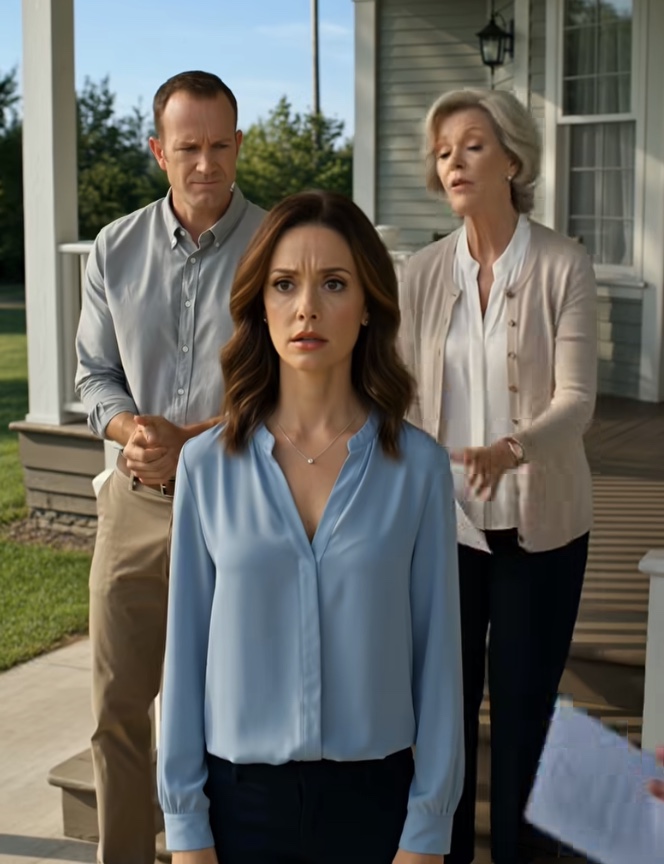
But when I returned home, the scene that met me on the porch froze me in place. Michael stood rigidly, his posture tight and uncomfortable, shoulder-to-shoulder with Vivian—my mother-in-law. Between them was a stack of papers, crisp and official. The sun glinted off the legal seals like tiny spotlights highlighting their scheme.
“The property is gone,” Vivian said, her voice flat, devoid of the warmth any mother-in-law should have mustered. “You’re homeless.”
I blinked, just long enough for her words to register, and then… I laughed softly. Not out of fear, not out of nervousness, but because for the first time in years, I realized I was in control of a game no one else even knew they were playing.
Michael’s gaze darted nervously away, fixating on the driveway. He said nothing, as if pretending not to see me would somehow reverse the reality that was closing in around him.
Vivian, undeterred, pushed the papers toward me. “The movers have already cleared everything out,” she continued. “Your belongings are in storage. Sign these documents—divorce papers. While you were mourning your grandmother, Michael finalized the sale without informing you. The buyers are on their way. This is just procedure. You can’t stop it.”
Their confidence was almost laughable. They believed grief had weakened me, that sorrow would render me compliant. They thought I would stand there, stunned, and take their scripted betrayal.
They were wrong.

Less than sixty minutes earlier, I had officially inherited seven million dollars from my grandmother’s estate. The legal documents were binding. Every clause, every signature had been validated in Boulder. The wealth they assumed I didn’t have was already mine. And I had a plan—though, at this point, even I wasn’t sure just how dramatic it would unfold.
A low rumble in the driveway drew Vivian’s attention. Her fake charm flared instantly. “There they are!” she said, smiling as though the arrival of the buyers was the final nail in my coffin.
Michael hurried down the porch steps, straightening his jacket and trying to force a friendly smile. But his movements were too measured, too rehearsed—like a man walking on a tightrope over quicksand.
Two men emerged from a polished black SUV. One was older, exuding quiet authority. He ignored the house, the “sold” signs, and most importantly, Michael’s hand extended in forced greeting. Vivian froze, her confident facade faltering just a fraction.
The older man’s eyes met mine immediately. “You’re Audrey, correct?” he asked, his tone calm, measured, but carrying unmistakable weight. “Margaret spoke of you many times. She thought very highly of you.”
It was the first time in hours that the world seemed to tilt. Vivian’s smile stiffened; Michael’s body froze mid-step. The air in the driveway became almost electrically charged, a tension so thick it pressed against my chest.
The man reached inside his coat and produced a sealed envelope. I recognized the handwriting instantly—my grandmother’s looping script, meticulous and precise. Every curve of the ink reminded me of her: smart, strategic, never leaving anything to chance.
“Margaret instructed me to deliver this personally,” he continued, “but only if certain conditions were met.” His gaze shifted toward Michael, sharp and deliberate. “She anticipated that if this estate were ever sold, transferred, or handled without your documented approval, serious misunderstandings could arise regarding its legal ownership.”
Michael’s face drained of color. Vivian’s shoulders stiffened. Even their carefully rehearsed plan suddenly looked fragile.
“What misunderstanding?” Michael asked, voice trembling just enough to betray him.
The younger man beside the older attorney opened a massive legal folder, the weight of it symbolic of the power it contained. He spoke evenly. “Before any transfer of possession takes place, all parties must review the trust restrictions governing this estate. Any attempt to bypass these restrictions could be legally challenged.”
Vivian’s composure cracked. Her smile wavered; her hands trembled slightly as she clutched the papers. Michael took a hesitant step back, eyes darting between us and the men, realizing for the first time that his carefully plotted ambush had been anticipated.
The older attorney handed me the envelope. I opened it slowly, savoring the moment. Inside were copies of the trust, detailed instructions, and notes from my grandmother herself—annotations in the margins outlining exactly what should happen if anyone tried to manipulate the estate or take advantage of my absence.
Every step they had taken to humiliate me, every assumption they had made about my vulnerability, had been accounted for. Every contingency, every “what if,” had been anticipated by Margaret Madison decades before she passed.
I looked at Michael, then at Vivian. “You see,” I said softly, my smile calm and cold, “the home you just sold… actually belongs to me.”
Vivian’s lips parted, then closed. She blinked, searching for a loophole, any shred of logic to cling to. Michael’s knees buckled slightly, though he attempted to hide it. The confidence they had carried into this confrontation—carefully rehearsed for months—evaporated in the span of a heartbeat.
I stood there, holding the envelope, and for the first time in twenty-seven years, I felt the weight of true power in my hands. Power that wasn’t just monetary, but strategic, legal, and moral. Power that came from foresight, from intelligence, from someone who had understood the human heart—and its capacity for greed—better than anyone else in the room.
“They thought grief would weaken me,” I continued, voice steady and deliberate. “They thought absence would make me vulnerable. They thought my grandmother’s passing would create a window for their schemes. But they forgot one thing.” I paused, letting the words sink in. “Margaret Madison was always ten steps ahead. And I… am her granddaughter.”
Vivian’s eyes flashed with anger, frustration, disbelief. Michael’s expression was unreadable, but I could see the panic creeping in at the corners of his composure. The black SUV, the attorneys, the sealed envelope—everything my grandmother had orchestrated—had shattered their illusion of control.
“And as for the buyers?” I said, glancing at the driveway. “They’ll have to wait. This property cannot be sold. Not without my signature. Not without the trust restrictions being honored. And that, my dear in-laws, includes every penny, every asset, every document.”
The room went quiet again. Vivian took a step back, then another. Michael’s hands trembled, and for the first time, I saw fear in the man I had once loved. It wasn’t fear of me—but of the legal, precise, unstoppable machinery my grandmother had left in place.
I folded the envelope carefully, as if handling a weapon more potent than any gun or sword. “The home, the estate, and everything contained within… has always been mine,” I said. “And thanks to Margaret’s foresight, no one can take it from me—especially not the people I trusted the most.”
For a long moment, neither Vivian nor Michael spoke. I could see the realization dawning in their eyes: their plan had failed, spectacularly, and their assumptions had been laughably naïve. Every manipulation, every whispered comment behind closed doors, every subtle attempt to discredit me—all of it had been anticipated and neutralized before it even began.
Then, slowly, I smiled. Not the tight, polite smile I had practiced for years, but a smile that carried relief, vindication, and the quiet satisfaction of someone who had been underestimated her entire life—and had won.
“This isn’t over,” I said softly, “but it begins here. And you should remember one thing: never underestimate someone who has been trained to survive, and never forget the woman who raised me.”
Michael opened his mouth, but no words came. Vivian’s expression faltered completely. Outside, the SUV engine hummed quietly, waiting to transport documents, not people, for once.
And in that moment, I realized the full scope of my grandmother’s gift. She had left me money, yes—but more importantly, she had left me the power to protect it, the tools to fight, and the certainty that justice, no matter how long delayed, was inevitable.
The real battle had only just begun—but I had already won the first round.