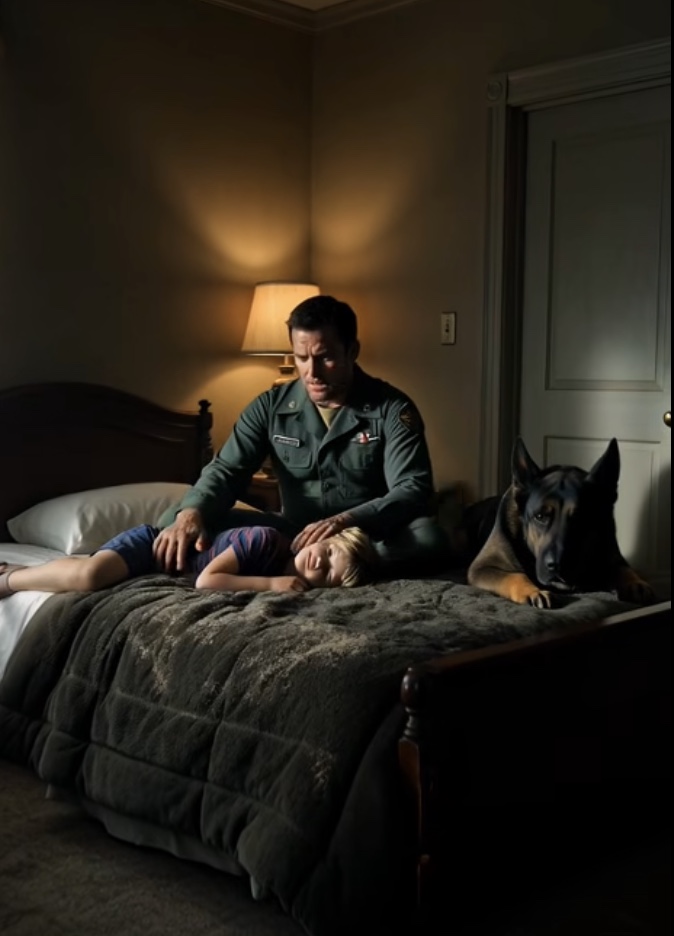
My name is Adelaide Whitlock, and for most of my life, the people closest to me believed I served in the wrong room. Not the wrong country. Not the wrong uniform. They would have denied that if anyone accused them of it. My father would have folded his retired Marine hands across his stomach and said he was proud that his daughter served. My brother Trent would have slapped my shoulder and called me “the smart one” in front of strangers, using that joking voice men use when they want an insult to sound like affection. My mother would have looked at me from the kitchen sink with quiet apology in her eyes, mouthing, I’m proud of you, because she had learned long ago that some truths were too dangerous to say out loud in our house.
But there are ways to be dismissed without anyone calling you useless. There are ways to become invisible at your own dinner table. There are ways to spend fifteen years keeping men alive overseas while those same men, and even your own family, imagine your work is a desk, a keyboard, a badge, and nothing more dangerous than stale coffee in a secure building. I was thirty-seven years old when the room finally saw me. It happened in a hotel bar in Coronado, California, under lights too bright for a place pretending to be comfortable, with club soda running across a ruined laptop and a Marine’s fingers locked around my wrist. It happened with my younger brother sitting three stools away, laughing because he had spent his life believing his service was the kind that counted and mine was the kind that explained things afterward. It happened because a man I had quietly protected for four years put his hands on me. And it happened because his commander walked through the door at the exact moment the lie became too large to survive.
My father, Walter Whitlock, retired from the Marine Corps the summer I turned fourteen. Before that, our house in Jacksonville, North Carolina, belonged mostly to my mother and the rhythm of deployments, school papers, laundry, phone calls, and the refrigerator calendar she kept in blue ink. My father came and went like weather. His boots arrived. His duffel bags arrived. His voice filled the rooms. Then he left again, and the house expanded around the silence. But when he retired, the silence retired with him. He took the seat at the head of the kitchen table, and without anyone announcing it, the house rearranged itself around him. Trent was eleven then. He took the chair on Dad’s right. I had always sat on the left, but after that summer, the right chair became the future. The left chair became furniture.
My father was not cruel in the obvious ways. He never told me girls did not belong in uniform. He never shouted that I was weak. He never forbade me to serve. What he did was simpler. He looked through me. Trent was the son, the future Marine, the continuation of a line my father believed had begun before him and would survive after him. I was the daughter who got good grades. When I brought home report cards, my father would glance at them and say, “Smart girl. Don’t let it go to your head.” Then he would move on to ask Trent about football practice, push-ups, discipline, toughness, and the Corps. My mother witnessed it all. She did not have the tools to fight him directly, but she had hands. She squeezed mine under tables. She ironed my uniforms with the same care she gave Trent’s shirts. She set my certificates where my father would have to see them. Sometimes, across the kitchen, she would silently mouth, I’m proud of you.
At seventeen, I told my father I had accepted an NROTC scholarship to the University of Virginia. We were sitting in his pickup near the marina in New Bern. I had rehearsed the sentence for two weeks. He turned off the radio, stared through the windshield, and said, “Navy officers are accountants in uniform.” Then he added, “If you’re going to serve, Adelaide, at least do it right.” I let him finish. Then I said, “I already accepted.” He drove home in silence. That was Walter Whitlock’s punishment. Not yelling. Not threats. Just silence so heavy it made breathing feel like disobedience. The morning I left for college, he walked me to the front gate of Camp Lejeune as if that were the only proper place to send someone toward service. He did not hug me. He touched two fingers to an old field cap and said, “Good luck.” Trent stood behind him with his hands in his pockets and said nothing.
College felt like a quiet room I had been waiting my whole life to enter. In NROTC, nobody knew me as Walter Whitlock’s daughter first. They knew my name, my scores, my work. I studied Russian, intelligence analysis, international security, and the hidden machinery of modern war. For the first time, I found rooms where people respected the person who saw danger before the danger arrived. I commissioned in 2011. My mother cried. My father shook my hand like I was the daughter of a colleague. “Congratulations,” he said, flatly. Trent smiled for photos, one arm around me, both of us still young enough to believe time would fix what pride had broken.
After commissioning, I reported to Norfolk and entered the intelligence world. I worked nights, then days, then deployed with a carrier strike group. By 2016, I was sitting in a tactical command center in the South China Sea, running an intelligence watch through a forty-eight-hour window I still cannot fully describe. I made calls in that window that were quietly written into classified after-action reports. Someone far above me read those reports and decided I had seen the pattern before anyone else was willing to name it. In 2017, I was selected for defense human intelligence training. By 2018, I was detailed to the Defense Clandestine Service. By 2022, I had moved into cover operations. That was the quiet room that became mine.
Cover operations is not glamorous from the outside. We build people on paper. Names. Jobs. Passports. Vendor records. Leasing documents. Customs trails. Digital habits. The ordinary mess that makes a false identity look true. We build the door a SEAL walks through in a foreign port when his real name cannot exist. We build the way back out. For fifteen years, I built doors. I built them for men whose names my family would have recognized with pride, men my father would have called warriors, men my brother would have called brothers. And while I did that, my family still described me as “working intelligence,” as if that meant I sat safely beneath fluorescent lights, arranging information for the people who did real things.
The Pacific Vista Hotel in Coronado sits close enough to Naval Amphibious Base that the bar often filled with men who carried themselves like they were never fully off duty. It was Friday, May 14, 2026. I had been in town nine days for the final in-person debrief on an Eastern Mediterranean rotation. The operation had not been routine, but nothing had gone hot. All hands came home. In my world, that is the cleanest definition of success. At 8:42 that night, I sat in the corner booth of the hotel bar, wearing jeans, a navy blazer, and a black T-shirt. My work laptop was open, my club soda with lime sat beside it, and I was writing the final encrypted summary owed to my director by Monday.
Then a man slid into the booth across from me. He was broad-shouldered, three drinks deep, and wearing a polo stretched across arms that worked for a living. A tattoo on his forearm told me enough in two seconds: reconnaissance dagger, SEAL team insignia. He was attached to a team I had been helping protect for four years. “You look lonely, sweetheart,” he said. “Buy you a drink?” I closed my laptop halfway. “I’m working,” I said. “Please give me some space.” He laughed and turned toward the bar. “Hey, Whitlock. Your boy needs backup.”
Three stools down, my brother Trent looked over. He saw me. He saw the Marine in my booth. And then his face did what it had always done in uncomfortable family moments. Confusion. Embarrassment. Then the quick decision to make everything easier by turning it into a joke. He laughed. Loud enough for the bar to hear, he said, “Bryce, relax. She’s just a desk officer. She works for the government. She’s not impressed by you.” I sat very still. I had been sitting in that bar for forty minutes. I had been sitting in that family for thirty-seven years. And in one sentence, my brother had given Bryce Ramos permission.
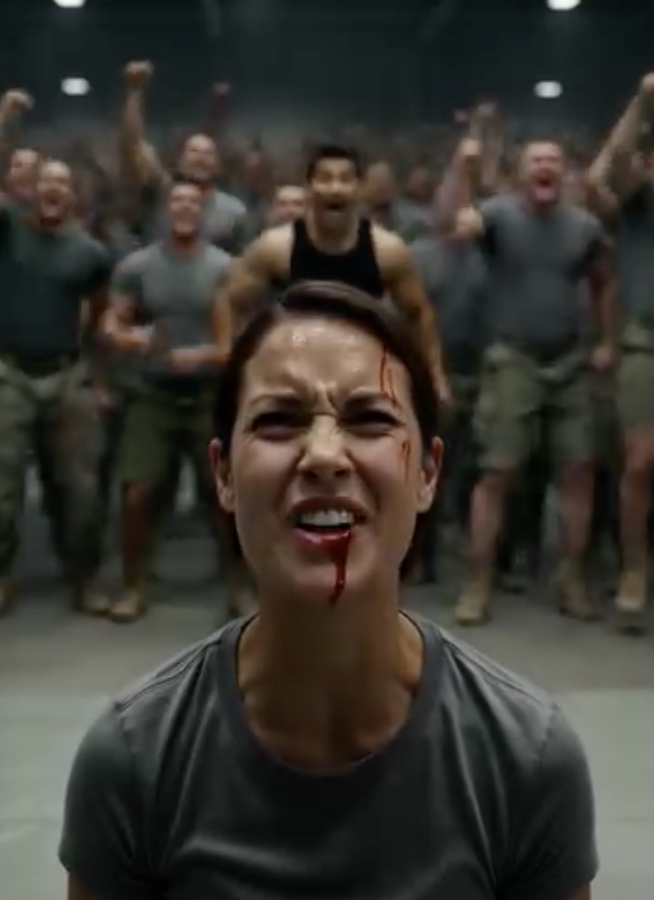
Bryce reached across the table and wrapped his hand around my wrist. He pulled my fingers off the keyboard. The club soda tipped over, ice and lime spilling across my laptop and into my lap. I felt the cold through my jeans. I did not flinch. “Staff Sergeant,” I said, evenly, “take your hand off me.” He smiled. “Or what, princess?” Then he stood, pulled me up by the wrist, and pressed his other hand against my shoulder, pinning me to the booth wall. His breath smelled of bourbon. His face was close enough for me to see the confidence in his eyes — the confidence of a man who thought he had chosen someone without consequence.
The door opened. Lieutenant Commander Eli Marsh entered with Senior Chief Damon Vance two steps behind him. Marsh had the kind of presence men notice before they understand why. He scanned the room once, the way operators scan any room, and his eyes stopped on the booth. He saw Bryce’s hand on my shoulder. Then he saw my face. Recognition landed. The entire temperature of the bar seemed to drop. Marsh did not run. He walked. His voice cut through the room, quiet and final. “Staff Sergeant Ramos, stand down.” Bryce released me instantly and turned. His body reacted before his brain caught up. Senior Chief Vance moved between us. Marsh stopped six feet away from me, but he did not look at Bryce first. He looked at me. “Commander Whitlock,” he said, “I apologize for my Marine. Are you all right?”
The bar went silent. My brother set his glass down so hard the rim cracked. I lifted the laptop. Water poured from the case onto the floor. Bryce’s face changed in real time as he realized the woman he had grabbed was not a civilian, not a secretary, not a nameless woman in a hotel bar. Marsh turned toward him, speaking loudly enough for everyone to hear. “Staff Sergeant, the woman you just put your hands on is the case officer who built your cover. She is the reason your team came home from Beirut. She is the reason you came home from this rotation.” Then Marsh looked at my brother. “Gunny,” he said, “she’s your sister.” Trent did not answer. He could not lift his eyes.
That night in my hotel room, I sat on the edge of the bed in a robe while my wet blazer hung in the bathroom and my ruined laptop sat useless on the desk. I had been touched by hostile people before in my career. I had been underestimated by men before. But I had never been wounded by my brother’s silence quite like that. The worst part was not Bryce. Bryce had seen a woman and decided she was small. The worst part was Trent. He had known me all his life and still chosen the same answer. At 10:15, my colleague Iris called. I told her what happened. She was quiet for a moment, then said, “File the report in the morning, not tonight. Tonight you will write it angry, and you don’t get to be angry on paper. You get to be a commander on paper. The two are not the same.”
The next morning, I texted Trent to meet me at the marina coffee stand. He arrived at 8:11 wearing PT gear, eyes shadowed from a sleepless night. He started with an apology, but it was the wrong kind. “Ad, I was drunk. I didn’t see what was happening. Bryce is a good guy when he’s not—” I stopped him. “That apology is for you,” I said. “Not for me. You feel bad about how this looks. You are not sorry yet about what happened.” He stared at the water. I showed him the bruise around my wrist, dark purple and thumb-shaped. “The man who grabbed me did it in front of you. Your first instinct was not to stand. It was to laugh. Your second instinct was to call me a desk officer. You handed him permission, Trent.”
He tried to say he would call Dad, that Walter would set Bryce straight. I said no. “Dad has spent forty years assuming my work was nothing. He does not get to fix this for you. You laughed. You tell him what happened. In person. Tonight.” Then I told Trent what I had never been allowed to tell him before in plain language. The Black Sea cover he had worn was mine. The redundant communications route that brought his unit back online after forty silent hours was mine. The Beirut protocol that saved his team was mine. “I have been protecting you,” I said. “And maybe I was also protecting you from the knowledge that you had been wrong about me your whole life.”
My brother covered his face with both hands. He sat that way for a long time. Trent did not cry easily. Marines like him were taught to bleed before they trembled. But when he lifted his head, his eyes were red. “Was Beirut my unit too?” he asked. “Yes,” I said. The door I built had brought him home too. He nodded slowly. “I’ll tell Dad,” he said. “And I’ll tell Bryce. I know sorry doesn’t mean anything yet.” I picked up my coffee. “It doesn’t mean nothing,” I said. “It just doesn’t mean what you want it to mean yet.”
The administrative process moved faster than I expected. Bryce Ramos was reduced in rank, removed from special operations attachment, and reassigned away from the team. Lieutenant Commander Marsh filed a clean, factual report. No drama. No speculation. Just what he had seen, where he had stood, and who had done what. My director supported the findings. For once, no one asked me to soften the truth so a man could keep his pride intact.
Trent drove to Jacksonville and walked into our parents’ kitchen. My mother stood at the counter. My father sat beneath the same light that had shone over a thousand dinners where Trent had been the future and I had been furniture. Trent told him everything. He told Walter he had laughed. He told him he had called me a desk officer. He told him about Bryce’s hand on my wrist, about Marsh walking in, about the words spoken in front of the bar. My father asked only one question. “And what did you do, son?” Trent answered, “I failed her.” My father did not speak for nearly an hour. He went outside and sat on the porch in the dark. My mother called me after midnight and whispered, “He’s still sitting out there, Addie. I have never seen him like this.”
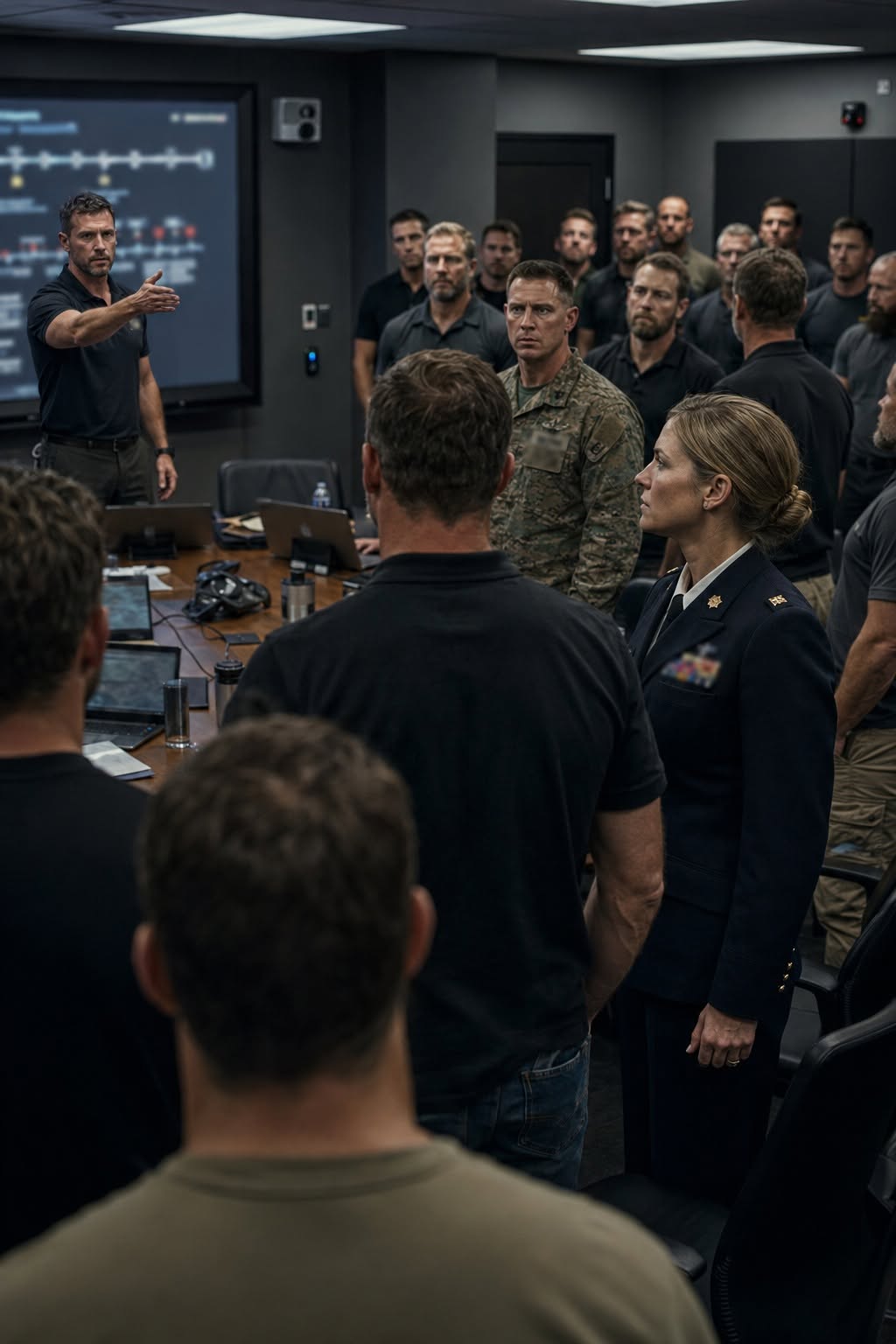
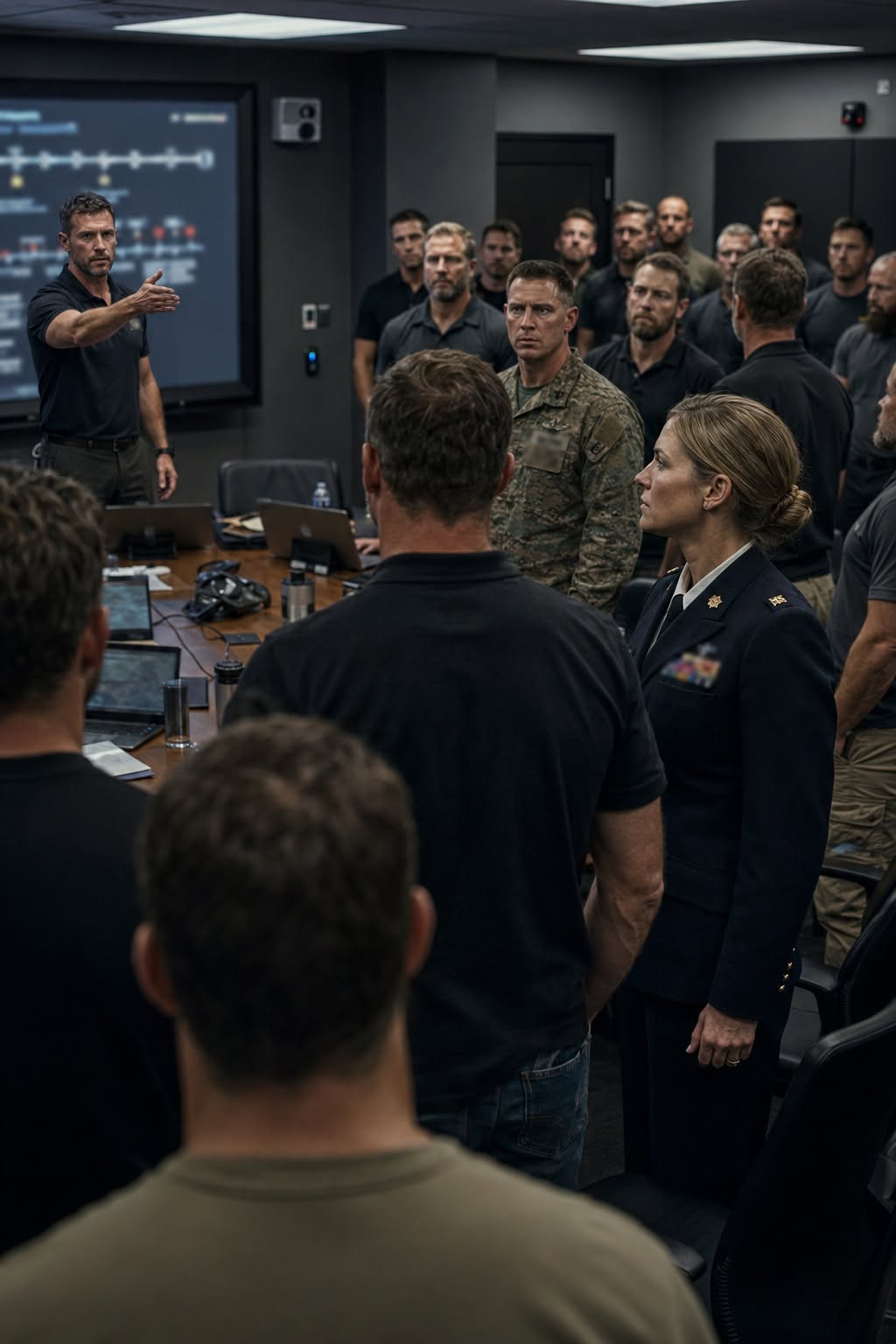
On May 28, I walked into a classified briefing room at Dam Neck, Virginia, wearing my Navy service uniform. Twenty operators sat beneath the harsh overhead lights. Marsh stood at the front and walked them through the Beirut protocol minute by minute. He explained how the first cover failed, why the second one held, and how the team got out because someone had built an escape route before they knew they needed one. For forty-five minutes, he did not name me. Then he turned toward the back row and said, “The reason you walked out was not luck. It was Commander Whitlock.” He looked at me. “Stand up, Commander.”
I stood. Twenty operators rose with me. Twenty men who had once passed through doors I built without knowing my face stood at attention. In the third row, my brother stood too. His eyes found mine, and this time there was no joke in them, no easy smile, no old family habit of looking past me. Only recognition. It was not enough to erase thirty-seven years. It was not enough to give back every dinner, every ceremony, every silent car ride, every time my father introduced Trent as the future and me as his daughter. But it was something.
Two weeks later, a letter arrived from my father. It was three pages long, written in his careful block handwriting. He did not excuse himself. He did not say he had been proud all along. He wrote, “I taught your brother to see service through the shape of a man, and I taught myself to ignore anything that challenged that. I was wrong. You served where I did not know how to look.” At the bottom, beneath his signature, he added one sentence that made me sit down before I could finish breathing. “You were never in the wrong room, Adelaide. I was.”
I kept the letter. Not because it fixed everything. It did not. Some wounds do not close simply because the person who made them finally understands the blade. I kept it because truth, when it arrives late, is still truth. My brother and I speak more carefully now. My father listens more than he talks. My mother no longer mouths I’m proud of you from across the kitchen. She says it out loud.
And me? I still work in quiet rooms. I still build doors. Most people will never know my name, and that is fine. The work does not require applause. But when I sit at a table now, in uniform or not, with men who think danger only wears one kind of face, I no longer wait for someone else to correct them. I know exactly who I am. I know what I have done. And I know that sometimes the person everyone calls “just a desk officer” is the only reason the warriors make it home.