My name is Imani Clark Richardson. I’m a physician, a healthcare administrator, and the director of a bustling community health center. But on that late spring afternoon, none of that seemed to matter. On that day, I was just a mother, carrying groceries up to my front door—and yet, I would soon become the target of a humiliation I’ll never forget.
It was 4:48 p.m. when I turned onto Elmwood Drive, a cul-de-sac in Riverside Heights, one of those neighborhoods that looked like it belonged in a magazine spread. Colonial-style homes, neatly trimmed hedges, and the kind of lawns where neighbors jogged at dawn while sipping on green smoothies. My husband and I had moved here only fourteen months prior, drawn by the charm and tranquility. At first, it felt like the American dream. But over time, I began to notice the subtle undertones: a note slipped under the door asking if the maid stayed overnight, neighbors who stared a bit too long, and the occasional whisper as I passed by.

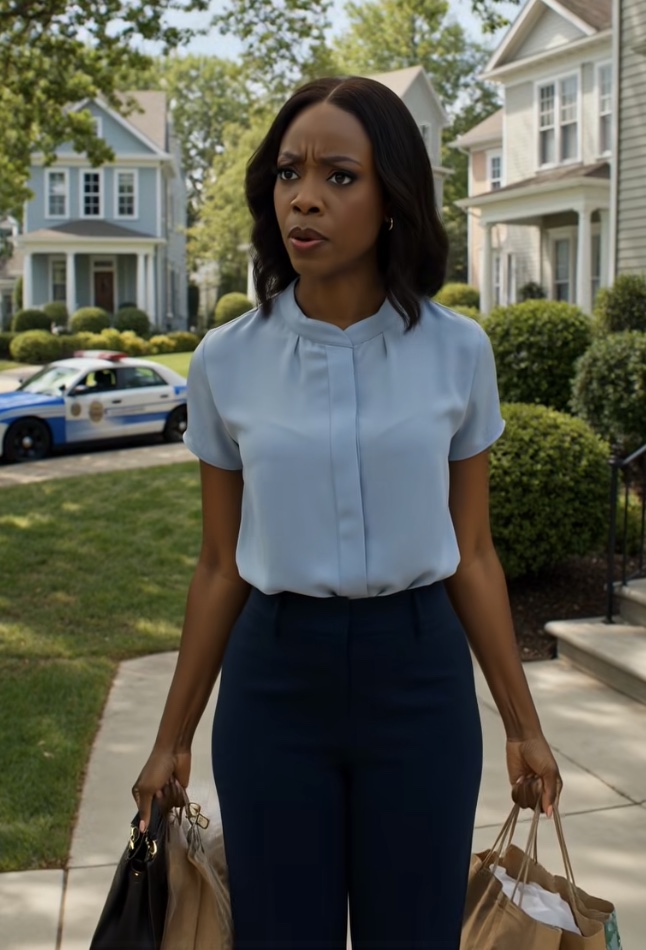
I didn’t see the patrol car until I had nearly reached my driveway. Two houses down, the vehicle sat there, engine off. At first, I dismissed it—maybe routine patrol. But something in the angle of the car and the way it seemed to block my neighbor’s mailbox made my stomach twinge, a tiny premonition I didn’t yet understand.
I pulled into my own driveway, turned off the engine, and began unloading. My hands were full with the groceries: a bag of produce in one hand, my purse and briefcase in the other. I set the groceries on the concrete doorstep, just above the three familiar steps that led to the front door. I fumbled for my keys, fingers closing around the metal, the tiny photo charm of my family warming against my palm.
“Excuse me, ma’am.”
The voice came from directly behind me. Calm, authoritative, but carrying a weight that made me freeze. I turned, and saw Officer Derek Hutchkins standing at the bottom of my steps. His patrol car now completely blocked my driveway, engine still humming softly.
“Can I help you, officer?” My voice was steady, though I could feel my pulse hammering.
He didn’t respond immediately. Instead, he let his gaze travel over me: from my face to the grocery bags, to the colonial house behind me. “I need to see some identification. Now.” His voice struck like a gavel.
My stomach dropped. I was at my own front door. My groceries sat behind me, harmless and yet now part of a confrontation I had not invited. I carefully pulled out my driver’s license from my purse and handed it to him.
“Imani Clark Richardson,” he muttered, lips moving as he read. Then his eyes narrowed. “This address?”
“Yes,” I said firmly.
For a moment, his gaze lingered, an unreadable calculation passing across his face. Then came the contempt. “Step away from the door.”
I paused, confused. My heart raced. “Excuse me?”
“Step away,” he repeated, voice low but iron-clad. His hand rested near his weapon, a silent intimidation. I obeyed, descending the three steps to the driveway, gripping my keys so tightly the metal pressed into my palm.
Now standing ten feet away from my own home, I felt every eye in the neighborhood—or so it seemed—upon me. Hutchkins moved into the space I had just left, positioning himself between me and the house as if to mark territory.
“You’ve lived here long?” he asked, almost rhetorically.
I kept my tone calm. “Fourteen months. My husband and I bought this house together.”
He cocked his head, a twisted smirk appearing on his face. “You? A doctor? And you’re living in a million-dollar neighborhood?”
My chest tightened. “Yes, I earned it.”
He snorted. “Sure. There’s no way someone like you could afford this legally. Who really owns this house? Someone… helping you?” His words cut like shards of glass. He suggested a sugar daddy. He suggested some wealthy white liberal benefactor. The implications were nauseating.
“I don’t need anyone’s help,” I said, voice even but my mind racing. “My husband and I purchased this home. Legally. And I’m going inside now.”
“I didn’t say you could go,” he barked.
I swallowed my fear. “On what legal basis am I being detained at my own home?”
“Step back. I need to search your vehicle.” He leaned slightly forward, the citrus-chemical scent of his cologne suffocating. “I smell marijuana.”

I froze. That was a lie. “I do not consent,” I said firmly, hands still gripping my keys.
His expression darkened. He reached for his handcuffs. “Hands behind your back.”
Time seemed to stretch. I was a mother, a homeowner, and suddenly a suspect in the eyes of a man whose authority seemed uncheckable. I could feel my pulse in my temples. My groceries sat on the doorstep, bags now heavy with the weight of humiliation.
At that moment, I heard the faint whirring of cameras from a neighbor’s window, the click of a door opening nearby. Hutchkins’ eyes darted momentarily toward the sound. That flicker of distraction was enough.
I didn’t speak, just slowly raised my phone from my purse and pressed record. Every step he took toward me was documented. Every lie, every insinuation, every misuse of authority. I spoke calmly, not to him, but to the camera: “I am at my own home. I have not consented to a search. I am documenting this.”
His face went from annoyance to rage. “Put that down!”
I didn’t. My hand shook slightly, but I kept it in place.
Then something unexpected happened. From across the street, headlights appeared. A delivery truck had stopped at the end of Elmwood Drive, and the driver, seeing the situation unfold, honked his horn twice. Hutchkins flinched. That split second was all I needed. I stepped forward—right onto the driveway, toward the patrol car. My voice was steady, louder now: “You are interfering with my legal rights at my own property. Step back.”
He attempted to block me, but the shift in the situation—the presence of witnesses, the recording, the delivery truck—unsettled him. And then, a crucial mistake: he stepped backward, losing his balance on the curb. My foot, almost accidentally, nudged the edge of the concrete step. He slipped. His patrol car, left in neutral, rolled slightly backward—hitting the edge of his own front bumper, spinning his tires against the asphalt.
The neighbors came out at the sudden noise. A few had their phones out. The delivery driver honked again, muttering something under his breath about “crazy officer.” Hutchkins scrambled to stop the patrol car, his face a mix of fury and disbelief.
It was over in seconds. No one was hurt, but the embarrassment was monumental. Here was a man who had assumed power over me, who had questioned my intelligence, my wealth, my right to exist in my own home—and now, his career teetered precariously on my driveway.
Later, when the police department reviewed the incident, the video I had recorded became the central piece of evidence. Hutchkins faced suspension, an internal affairs investigation, and the potential loss of his badge. I, meanwhile, stood on my doorstep, groceries forgotten, heart pounding, realizing that sometimes justice doesn’t come from authority—it comes from being prepared, calm, and documented.
I never imagined a routine afternoon, returning from the grocery store, could turn into such a defining moment. But it did. It wasn’t just about a driveway. It was about standing up for myself, for my rights, and for anyone who has ever been made to feel less than in their own home.
The irony wasn’t lost on me. Minutes earlier, the radio had discussed police reform. The world can be cruelly ironic at times—but sometimes, it also delivers poetic justice.
I finally stepped inside, closed the door behind me, and sank against it. My hands still shook from adrenaline, my groceries abandoned. But for the first time in that confrontation, I felt entirely free.
Because that afternoon, on my driveway, the man who tried to humiliate me discovered a truth he hadn’t anticipated: power is fleeting, but preparation, dignity, and courage are not.
And in the end… his career, quite literally, ended where he thought he could intimidate me.